


I’m attending the 2026 annual convention of the International Association for Impact Assessment (IAIA) in Quebec. Most US states and most countries require Environmental Impact Assessments, EIAs, to evaluate projects that are large or significant enough to have major environmental impacts. An EIA is a report detailing a project’s or a program’s expected environmental impacts. EIA laws vary quite a bit from state to state and country to country, and here are some of the ways:
Which projects and programs require EIAs?
Which impacts must be analyzed? Some jurisdictions don’t require climate impacts to be considered in EIAs.
Which government agency approves EIAs?
Can lawsuits challenge the EIAs? If so,
Do NGOs (non-governmental organizations, public-interest nonprofits) have standing to sue?
What remedies are available in court?
Who pays attorney’s fees—both parties, the loser, or is it asymmetrical?
Do EIA laws require mitigation of significant environmental impacts or approval of alternatives with smaller impacts?
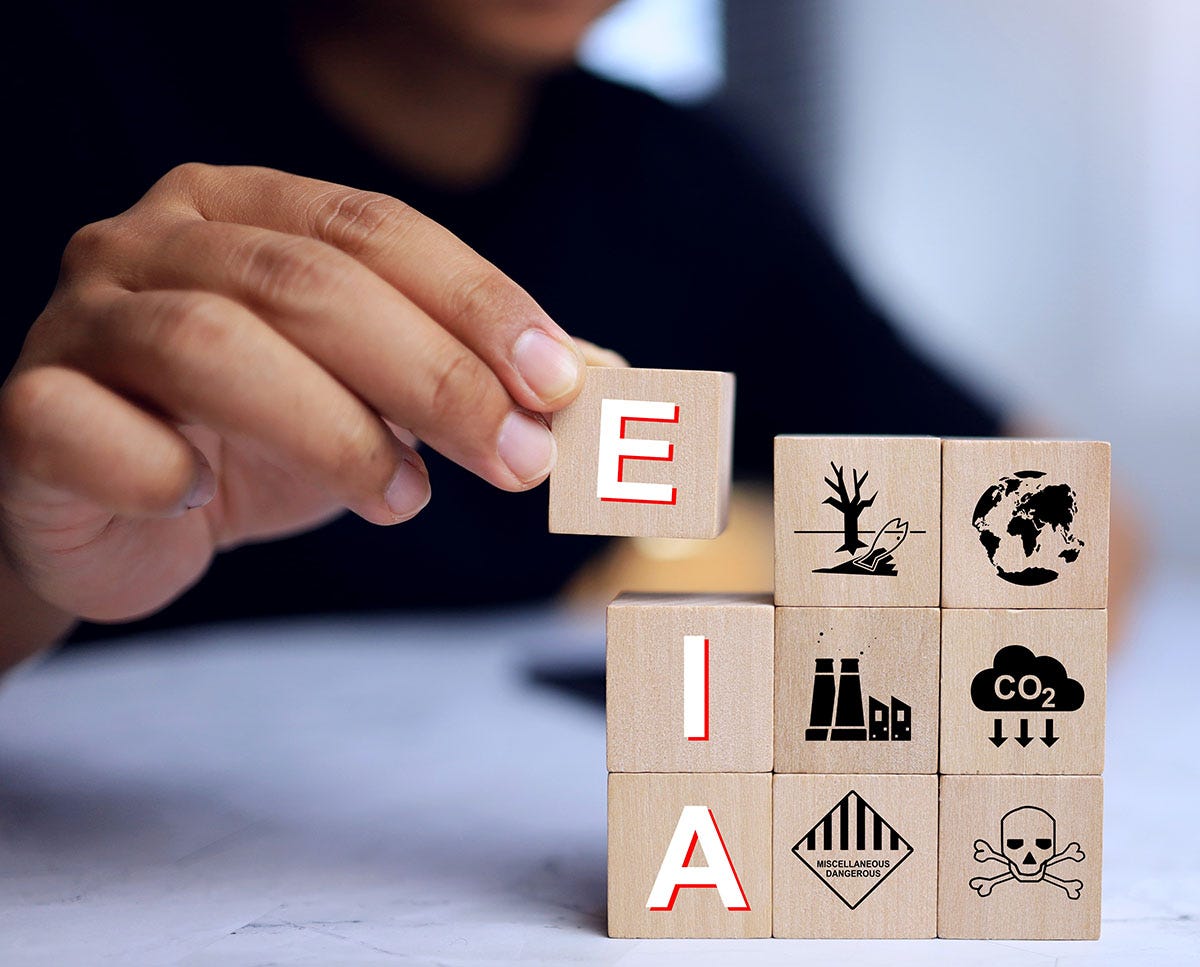
NEPA, enacted in the US in 1969, was the first law in the world requiring EIAs. The purpose of such laws is to ensure that government agencies know the environmental consequences before approving projects. Before NEPA, this information was not ordinarily included in approval documents and agencies approving projects sometimes had no idea how much the projects would harm the environment. Now, more than 190 countries require EIAs for some types of projects.
Given that my focus is climate change, the question I’m most interested in is: Does the EIA process contribute significantly to the fight against climate change? A lot of effort and money goes into the process. In the IAIA session I just left, a senior consultant who works on Canadian mining EIAs said that her most recent EIA was 22,000 pages long, and was developed by a staff of 200 consultants over a period of several years.
Most EIA laws require disclosure of a project’s greenhouse-gas (GHG) impacts. But a mere quantification—listing the number of metric tons of GHGs the project will emit each year—means little to most decision makers or the public at large. The determination, required by California’s EIA law, the California Environmental Quality Act (CEQA), of whether the impact is “significant” is often contrived to reach a conclusion of non-significance, and therefore provides little guidance to the reader. But disclosing the emissions level allows the public to comment on ways the project will affect the environment, and to complain about potentially high GHG emissions.
My firm has used CEQA to induce companies building warehouses to mitigate their GHG impacts. We settle most of the cases, but we’re significantly helped by CEQA’s requirement that significant impacts be fully mitigated. We can say, when we settle a case, that we’re just asking for the mitigation that the court would order if we won the case. But this strategy doesn’t work as well in the majority of jurisdictions where the EIA law contains no requirement for mitigation.
I chaired a panel titled “EIA Litigation Around the World” at the IAIA conference. I talked about our CEQA warehouse GHG program in California. A researcher from South Africa discussed EIA appeals in that country. EIAs aren’t judicially reviewable there (i.e. no litigation per se), but NGOs can dispute an agency’s EIA approval by appealing it to the minister, which serves some of the same purposes. A researcher from Germany talked about EIA litigation there; the main issue, as it is in many of the EU countries, is standing for NGOs. Germany has gradually relaxed the standing requirement; in early days, a plaintiff in an EIA lawsuit had to show that he or she was personally harmed by the EIA approval, effectively barring most NGO lawsuits. Now, certain environmental NGOs may sue. Standing is also an issue for NEPA lawsuits in federal court in the US.
Mine was the only session out of about 140 sessions that dealt with litigation. This is partly due to the fact that most of the attendees are consultants who prepare EIAs or officials who work for government agencies that approve them. In California, my experience is that the agencies approving EIRs often don’t exercise proper due diligence, so they let the developer’s consultants slant the EIRs to minimize the project’s environmental impacts. EIR consultants are supposed to be governed by an ethics code—there were sessions on this at the IAIA convention—but the consultants are paid and given direction by the developer in most cases. Under these circumstances, litigation, or the possibility of litigation, provides an important check on the EIA.
EIAs are traditionally focused on the local area around the project. Climate change is different than other types of impacts because of the large scope of the problem in space and time. Every project’s GHG emissions affect the whole world for thousands of years to come.
We’re already in big climate trouble with the status quo. GHG concentrations will continue to rise, causing heat waves, sea-level rise, and a raft of other degradations of our planet, until we reach a global net zero. At that point we will be stuck for thousands of years with the amount of temperature rise that’s occurred. We’re nowhere near a path to achieving net zero, mostly for political reasons. We know that we can cost-effectively replace fossil energy with renewables in electricity generation and automobile transport, but the political will isn’t there.
My opinion is that every project that requires an EIA should be net-zero for GHGs. New projects should not increase the emission of greenhouse gases. New non-net-zero projects add to global heating. It wouldn’t be unreasonable to go even further than net zero and require new projects to contribute to the solution by providing enough mitigation to have substantial net-negative GHG emissions proportional to the size of the project. But right now the political tide is running toward eliminating regulations that restrict development in order to increase abundance and affordability. We’re focusing on short-term economic benefits at the expense of the long-term health of the planet.
But discussing these technical issues sidesteps the main question. Are we doing any good with assessments of climate impacts in EIAs? I often use effectiveness as a litmus test for environmental action. Many of my fellow environmentalists spend a lot of effort on things that are ineffective and do no good for anyone. For example, when I was affiliated with the Sierra Club a few years ago, the club would spend a huge amount of effort developing club policies on a wide variety of issues. I remember one meeting in which the board of directors spent hours revising the details of the club’s policy on agriculture, following a multi-person-year effort by staff and volunteers to develop the policy. It was largely a wasted effort. Who cares what the Sierra Club thinks about agriculture?
One limitation on EIAs’ effectiveness is that decision-makers often fail to read or understand EIAs. A lawyer for another plaintiff in a case I recently tried in court in Oakland argued that the project’s EIR violated CEQA because the links to outside support documents in comment letters included in the EIR were not reproduced well enough that they could be accessed. This may technically be a CEQA violation, but the idea that the members of the board approving the project would even try to access such documents is unrealistic. The draft EIR, including appendices, had over 10,000 pages. It contained a discussion of the project’s GHG impacts that was long and confusing. It disclosed an estimate that the project would result in the emission of an additional 95,981 metric tons of GHGs per year by 2038. Did the board members know if this was a large number?
Even if these disclosures aren’t widely understood by the public and decision-makers, they do some good by providing a reminder that the project does have GHG impacts. California law allows us to file a lawsuit asking the court to order that these impacts be fully mitigated. California’s EIA law is the only such law requiring such mitigation, but in some jurisdictions, such as the Netherlands, the EIA can interact with the local climate law to require GHG mitigation. And in Canada, if a project is not “net-zero compatible” by 2050, the federal government can determine the project is against the public interest and deny approval. EIAs are much more effective as tools to fight global heating if they have some hook to substantive law requiring mitigation or allowing project denial on GHG grounds, instead of being merely disclosures of the project’s impacts.
We should be working with legislatures around the world to push EIA and climate laws to require full disclosure of GHG impacts, and full mitigation for them. California’s CEQA is the currently the only EIA law that does the latter. Unfortunately, there is currently a strong movement to scale back CEQA. A ballot measure from the California Chamber of Commerce is very likely to qualify for inclusion on the ballot for the November 2026 election, and would strongly curtail CEQA. Let’s hope it fails in the election. CEQA is a valuable tool for protecting the environment, and has much less impact on projects than its opponents claim.
In the last few years I’ve gone to a number of environmental law-related conferences. For the most part, they provide the presenters with an opportunity to publish, which is important to academics. And they provide the attendees with an opportunity to travel to an interesting place like Quebec, conference tourism. But most of their presentations provide little that will help practitioners do a better job. At the IAIA Conference, for example, a 90-minute session on outreach during the EIA process emphasized the importance of conferring with the public as fully as possible, a really obvious point. The main value may be the networking available during the lunches and coffee breaks.
A major theme of the conference was dealing with misinformation and disinformation, probably largely inspired by the anti-science efforts of the current US federal administration. Only six IAIA session dealt with climate change. Half of them dealt with adaptation—how climate change will affect the project and how the project has been climate-proofed; the other half focused on how EIA practitioners should deal with climate misinformation. Climate is a difficult topic at this conference because it is treated so differently in EIAs in hundreds of jurisdictions. But climate change is the most important issue facing the world today, and deserves a larger share of the attention at a conference like IAIA’s.